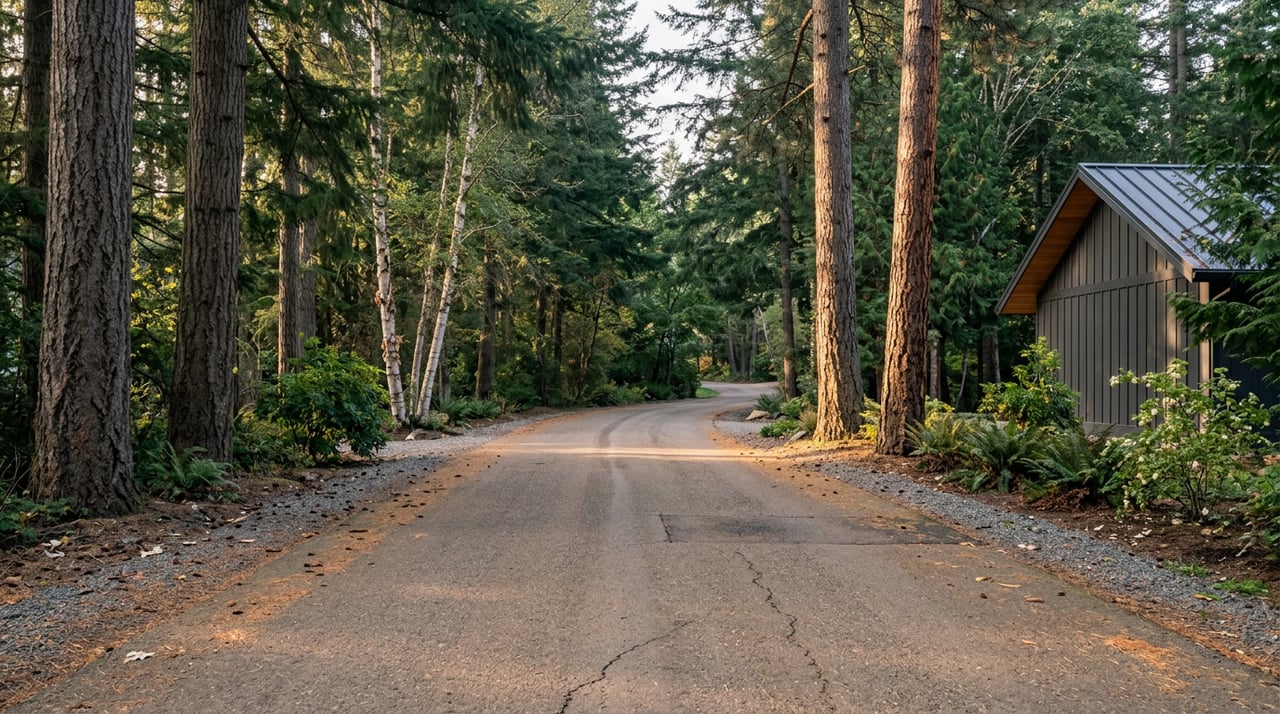
If you stepped outside for coffee on the morning of August 8 this year, you likely heard them before you saw them. A low hum of gears shifting down, then the click and grind of a couple hundred cyclists working their way up the last real hill on a 40-kilometer course. Somewhere near the top of that grade, in the cul-de-sac at the end of Mullan Trail Road, race marshals waved riders through a U-turn and sent them straight back down the way they came.
That is the entire cameo Mullan Trail Road plays in the Coeur d'Alene Triathlon each year. One turn. One out-and-back climb. Then the pack disappears back toward Sunnyside Road and the lake, and the street goes back to whatever it was doing before 7 a.m.
The fact that this particular stretch of pavement gets singled out as the challenging uphill section of the course says something about the ground itself. The name on the street sign says something older still.
The Route, Turn by Turn
This year's race marked the 42nd running of the Coeur d'Alene Triathlon, held Saturday, August 8, starting and finishing at Coeur d'Alene City Park. Olympic-distance athletes began with a deep-water swim, boarding a cruise ship that carried them out into the bay before they dropped into the lake and swam back to shore. The Scenic Sprint launched an hour later straight off the City Park beach, a shorter 500-meter swim followed by a 13-mile bike leg and a 5K run. Duathlon competitors skipped the swim entirely and rode the full 40-kilometer bike course.
For anyone doing the Olympic distance or the full duathlon route, the official race directions send riders inland partway through the bike leg on a specific sequence. Right onto 11th, left on East Mullan Avenue, right onto Coeur d'Alene Lake Drive, up and over Bennett Bay Hill, then a turn partway up that hill onto Yellowstone Trail, left onto Bonnell Road, and finally right onto East Mullan Trail Road itself. The turnaround sits at the cul-de-sac. Riders retrace the same climb back down to Sunnyside Road, where the race's own course notes warn competitors that the descent back toward the lake moves fast enough to require real caution.
That is not a generic hill tacked onto a flat lakeside loop to add mileage. It is the one section of the entire bike course organizers flag by name as the hard part, and it sits on a road most of its neighbors drive at 25 miles an hour without a second thought for the other 364 days of the year.
Why This Hill, Specifically
Riders have already cleared one climb by the time they reach Mullan Trail Road. Bennett Bay Hill comes first, right off Coeur d'Alene Lake Drive. The route sends competitors up a second grade, on a dead-end road with a built-in turnaround. That second grade is one more real test before the run leg, and it falls on Mullan Trail Road.
The run course, once cyclists are back at City Park, follows the Centennial Trail north along the Spokane River, with turnaround points at the University of Idaho and Lewis-Clark State College Harbor Center for the 5K and near the Seltice Way overpass for the 10K. The whole event closes back at City Park, where food, awards, and a beer garden wait for finishers. Mullan Trail Road gets its few minutes in the middle of all that, then disappears from the story again until next August.
A Name Older Than the City Itself
Mullan Trail Road did not get its name from a developer's brochure. It refers to the Mullan Road, the 624-mile military wagon route Captain John Mullan and his Army crew built between 1859 and 1862 to link Fort Benton, Montana, on the Missouri River, with Fort Walla Walla, Washington, on the Columbia. It was the first engineered road across the northern Rockies, cut through 120 miles of dense timber at a cost of roughly $230,000, with river crossings spanned by more than 160 bridges along the full route.
The section that runs closest to home came out of a mid-project change of plans. Mullan's original alignment swept south of Lake Coeur d'Alene, but flooding risk along the St. Joe River forced a rework. In 1861, Congress appropriated another $100,000 so Mullan could push the road north of the lake instead, through heavily forested country similar to the ground Mullan Trail Road sits on today.
That same summer, on July 4, 1861, Mullan's crew paused work long enough to mark the occasion. One of them carved the initials and date into a large white pine at a mountain pass east of town. Kootenai County's own history materials list that spot as the likely site of the first Fourth of July celebration in the future state of Idaho. The pass has been called Fourth of July Pass ever since, and the carved section of that pine, known locally as the Mullan Tree, survived until a windstorm snapped its top off in 1962. The remaining blazed stump was preserved and is on display today at the Museum of North Idaho on East Young Avenue, at the base of Tubbs Hill, a short drive from the cul-de-sac where cyclists turn around each August.
Travel on the finished road increased for a few years, carrying settlers, pack strings, and at least one recorded camel caravan headed to and from the Montana gold fields. Use dropped off after 1865 once maintenance stopped, until General William T. Sherman, touring the West in 1877, ordered the road repaired and a new post built nearby. That post became Fort Sherman, and repairs to the Mullan Road were finished in 1879, giving the corridor a second working life decades before automobiles ever used it.
So the road's name is not a marketing flourish. It points directly at a 19th-century engineering project that determined, in a literal sense, where routes through this part of North Idaho would run, decades before there was a Coeur d'Alene city government to name a street after anything.
Forty Homes, One Loud Morning
Lake Forest at Mullan Trail keeps a small footprint by any measure. It's just 40 home sites spread across 128 acres, with 70 of those acres held as common greenbelt. The location sits close enough to downtown Coeur d'Alene that the drive in takes minutes, yet the road itself, paved and served by natural gas, underground power, and a community water system, still feels more rural than urban. Most days, the loudest sound on Mullan Trail Road is wind moving through the trees that make up most of that greenbelt.
Then, one Saturday morning a year, that quiet gets interrupted by a few hundred people in spandex racing each other up the same grade Mullan's crew once cleared through timber with axes and mule teams. The two facts sit side by side without much overlap most of the year: a private, wooded cul-de-sac neighborhood, and a name tied to one of the more significant road-building projects in the region's early history. Race day is the one morning those two identities actually touch.
If you live here, that's worth knowing the next time triathlon signage goes up along Sunnyside or you catch the tail end of a rider's gears shifting through an open window. The grade under your street has been worth building a road over for more than a century and a half, whether the traffic on it was a mule train or a bike pack.
For neighbors curious about more stories like this one, or anyone weighing a future move to a road with this much history behind its name, Sarah Griffin at Griffin Signature Living is always glad to talk North Idaho.